
A conversion funnel is a sequence of steps users take from their first interaction with your app to a target action — making a purchase, completing onboarding, or reaching a specific level. At each step, some users drop off. The funnel shows you where, and by how much.
For product teams, funnels answer: where are we losing users before they convert?
For UA teams, they reveal whether traffic from different channels actually reaches the monetization stage. This glossary entry covers how to build a conversion funnel, read drop-off rates, and act on what you find.
What Is a Conversion Funnel?
A conversion funnel maps the path from a starting event to a target event — and counts how many users make it through each step along the way.
The name comes from the shape: wide at the top (all users who started) and narrow at the bottom (users who completed the goal). At every step between entry and exit, some users leave. The question the funnel answers is: which step loses the most, and why?
Example: you want to measure how many users who install your app make a second payment.
| Step | Users | Conversion |
|---|---|---|
| Opened app page | 1,000 | — |
| Downloaded the app | 500 | 50% |
| Made first payment | 20 | 4% |
| Made second payment | 18 | 90% |
The bottleneck is obvious: only 4% of users who downloaded the app made a first payment. That's the step to fix — not the step between first and second payment, which converts at 90%.
Screenshot: [conversion funnel from devtodev]
Learn more about conversion funnels and how to analyze them →
How to Build a Conversion Funnel
1. Define the goal. What action do you want users to take? First payment, tutorial completion, level 10 reached, subscription activated. The goal determines which steps to include.
2. Map the steps. List every action between install and goal. Keep it to the steps that actually matter — too many steps make the funnel hard to read and harder to act on.
3. Count unique users at each step. Funnels count unique users, not sessions or events. A user who completes Step 2 three times still counts once.
4. Calculate step-by-step conversion. Conversion between steps = users at Step N / users at Step N-1 × 100%. This tells you the drop-off rate at each transition — where you're losing users, not just where they end up.
5. Track overall conversion. Overall funnel conversion = users who completed the goal / users who entered the funnel × 100%. This is the headline number — but step-by-step conversion is where the diagnosis happens.
How to Read Funnel Drop-off
Not all drop-off is equal. The step with the highest drop-off isn't always the most important to fix.
High drop-off early in the funnel — usually an onboarding or FTUE problem. Users aren't understanding the product or hitting friction before they reach the core experience. Fix this first: every downstream metric depends on getting users past the first few steps.
High drop-off at the paywall — a monetization problem. Users are engaged but not converting to paying. This could be pricing, timing, offer framing, or friction in the payment flow. A/B test the offer before assuming the price is wrong.
Low drop-off throughout, low overall conversion — a traffic quality problem. Users are making it through the funnel but the funnel itself starts from a small base. Look at acquisition channels — are they sending users who match your target audience?
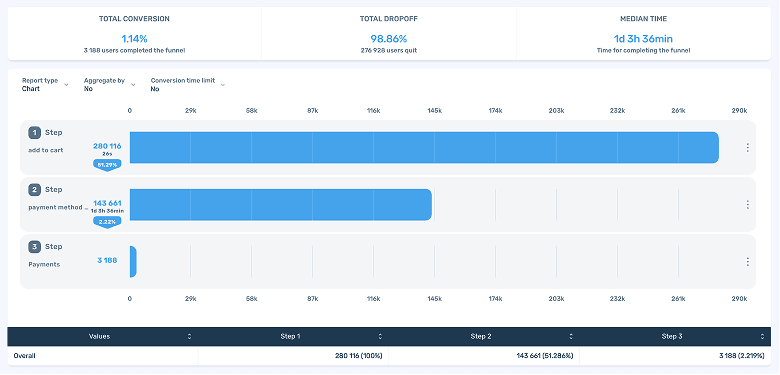
Screenshot: devtodev purchase funnel — 280k users added to cart, only 3,188 completed payment. The bottleneck isn't awareness, it's checkout friction.
How to Use Funnels in devtodev
In devtodev, you can build conversion funnels for any sequence of events — payment flows, tutorial steps, feature adoption paths, or custom user journeys. Funnels update in real time and can be filtered by segment, country, acquisition channel, or device type.
Compare funnels before and after a product change. Build the same funnel for two time periods — before and after an update. If conversion at a specific step improved, the change worked. If it dropped, you caught a regression.
Segment funnels by acquisition channel. Users from different sources often behave differently inside the funnel. A channel with high install volume but low funnel conversion isn't driving valuable users — it's inflating the top of the funnel while the bottom stays flat.
Compare funnels across countries. The same funnel can convert very differently across markets. A paywall that works in the US may underperform in Southeast Asia. Building separate funnels by country reveals where to localize pricing or offers.
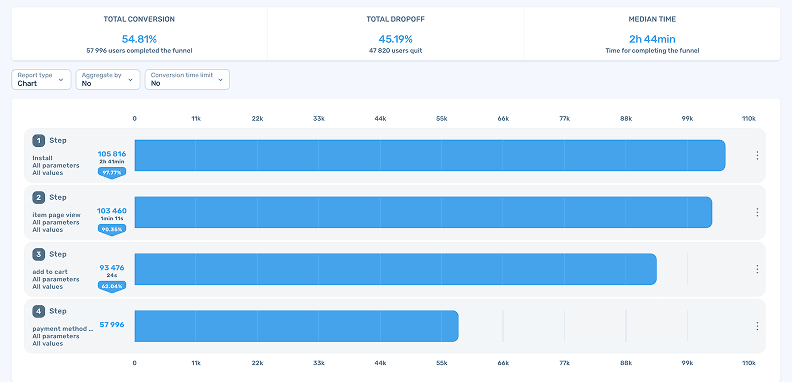
Screenshot: devtodev funnel showing Install → Item page view → add to cart → payment method. Strong early retention (97.77% to item view) with a sharp drop at checkout — the fix is in the payment flow, not the onboarding.
Learn more about analyzing monetization with devtodev →
Takeaways
- A conversion funnel maps the path from entry to a target action and shows drop-off at every step.
- Focus on the step with the highest drop-off — that's your bottleneck, not the last step before the goal.
- Overall conversion is the headline; step-by-step conversion is where the diagnosis happens.
- High early drop-off = onboarding problem. High paywall drop-off = monetization problem. Low overall conversion from a full funnel = traffic quality problem.
- Compare funnels before and after product changes to measure real impact.
- Segment funnels by channel and country — the same funnel converts differently across audiences.
Find where users drop off before they convert — and fix the right step. Explore devtodev →